Last year, I took up the banjo. I started learning to play the banjo because we had one, not because I had any particular affinity with banjo music or anything. My husband comes from a very musical family, in which musical instruments are normal things to ask for for birthdays and Christmas, and so one year they had given him a banjo. And then I was looking for a hobby, especially something that required my full embodied attention. So Loel dug up the banjo out of the closet, I found beginner’s banjo lessons on Youtube, and off I went.
I’m not very good, but getting good is not the point. I don’t really care if I ever get ‘good’ at banjo. I enjoy learning new things, and I love broadening my horizons. Before, I had no idea that the banjo might feel like the quintessential American instrument, but it actually has its roots in Sub Saharan Africa. It came to America via enslaved people. (In that sense, it is quintessentially American—both because enslaved Africans and their African-American descendants helped make America, but also because the legacy of slavery is woven into our national story in ways we can’t and shouldn’t even try to deny.) In short, banjo is a much more complex instrument than its ‘hillbilly’ legacy might have you think. How cool is that?!
In Zen Buddhism, there’s a concept called ‘beginner’s mind,’ and it is about approaching situations with an open mind, without judgement or preconceived ideas. You could contrast it with an expert’s mind, in the sense that experts are so practiced at what they do that they stop seeing new possibilities. (“But we’ve always done it this way” is the church version of an expert mind.) But it’s also about being more forgiving with ourselves, more compassionate, less judgmental. It’s a great framing when you try something new, like learning a musical instrument, but I actually think it’s also great for discipleship—for living out our faith every day.
Christian contemplative Richard Rohr urges people to “pray for the grace of beginner’s mind,” as he says that “what blocks spiritual teaching is the assumption that we already know.” We think we already know what God wants, or what we’re supposed to do or be in this life, or who we are. We see the problems and injustices around us and we don’t see how they get better.
It’s easy to feel hopeless. But the grace of beginner’s mind invites us to take a different stance.
I’ve been humming one particular song to myself a lot lately. It’s one of our third Sunday songs, the one that goes like this: another world is not only possible, she is on her way/on a quiet day, I can hear her breathing/She is on her way(“Another World,” Ana Hernandez). That’s my beginner’s mind practice when I don’t know what to do. It reminds me that God’s desires for us are bigger and better than we can ask or imagine, and what’s more, it’s not my job to dream up this new world—that’s God’s job. It’s my job to keep my eyes and ears open and my feet moving. Even when I don’t know exactly where I’m going, I do know that each step I take in Love, and towards Love, and with Love, is the right one. God will do the rest.
The light shall shine in the darkness and the darkness shall not overcome it (John 1:5)
You have probably noticed that the Church likes metaphors of darkness and light. We see them in Advent, with our lighting of Advent candles and our readings and hymns about banishing the darkness. And we see them in Lent, where darkness comes to stand for austerity, sobriety, repentance, and sorrow.
As humans we often have an uneasy relationship with the dark. We give our children nightlights and reassure them there are no monsters under the bed. When I go to bed, there are plenty of times I crawl out from under the covers to go check the lock on the front door just one more time, to make sure whatever is out there at night stays out there. When we go camping, we light campfires for warmth and for ‘smores, sure, but also to keep the darkness at bay. It resonates with us on a primal level when the Bible uses light vs dark as a shorthand for purity vs depravity.
But our metaphors are not free from the legacies of colonialism, slavery, and racism that are a constant presence in American life. The language of ‘white’ and ‘black’ is racialized in our country and in many other places around the world. It feeds into existing structures that consider whiteness to be good, and blackness to be bad, with all the devastating and deadly consequences of white supremacy that follow.
But it doesn’t have to be this way. Recently I picked up the picture bookGod’s Holy Darkness by Sharei Green and Beckah Selnick (illustrated by Nikki Faison). It’s a beautiful and thoughtful book that highlights “the beauty and holiness and goodness of Blackness and darkness and night.” Because like most things in the Bible, darkness is a symbol with many layers.
Creation–an act of God done only for love–starts in the dark, the authors point out. When God promises Abraham he will be the father of a great people, God takes Abraham outside at night to count the stars. God liberates the people of Israel in the dead of night. And Samuel’s calling, if you remember the story, could only happen at night. In striking illustrations, the authors explore the many ways the Bible disrupts the binary of white=good and black=bad.
As children of God, we are called to the difficult work of resisting white supremacy and dismantling the (internalized) seeds of racism and anti-blackness in our lives–including our spiritual lives. And so I ask you, what if we thought of Lent not as a time of darkness in which we are waiting anxiously for the light to appear to vanquish the dangerous darkness, but as a chance to spend forty days in the comforting and nurturing darkness of the womb, where life begins and grows? As we enter deeper into Lent, I invite you to let your eyes adjust to the dark and watch for the beautiful works of God’s holy darkness all around us.
Pick up a copy of God’s Holy Darkness for yourself on Amazon or your local independent bookstore. And if you would like to read more about this issue, this is a good place to start.
This reflection was originally published in the weekly newsletter of St. Anna’s Episcopal Church in Antioch, CA
As part of my Clinical Pastoral Education program with the San Francisco Night Ministry this summer, I’m learning about non-profit fundraising and effective storytelling. Want to support the work of the Night Ministry and help me reach my fundraising goal? Please click here to donate. Here are links to the first and second installment of this series on my experiences this summer.
This is a sermon about my work with the Night Ministry that I preached at Transfiguration Episcopal Church in San Mateo, CA on August 8, 2021. The readings that day were taken from the Feast of the Transfiguration (August 6); I chose to preach on Exodus 34:29-35.
In the text from Exodus that we just read, Moses is set apart from the rest of the Israelites. After his forty days with God, he is visibly different from the rest of humankind. His face is “shining,” the text tells us (verse 35), and must be veiled, suggesting not a subtle glowing but something “terrifyingly luminous,” a “divine radiance.”1 The Israelites are scared to come near him until he veils, until he protects them from the holy. And that’s what I want to talk about today: fear, veils, and the holy.
This summer, I’ve been working with San Francisco Night Ministry, an organization that for fifty years has been providing spiritual care to the vulnerable and marginalized in San Francisco. As part of the ordination process, our diocese requires postulants to take one unit of Clinical Pastoral Education, and I chose to do mine with the Night Ministry. Since the beginning of June, I have been spending five nights a week taking calls on the care line, helping lead outdoor worship and community programs, and doing what we call night walks. From 10pm to 2am, night ministers and students slowly and deliberately walk through the city to talk with, pray with, and sometimes just sit with people who need it. We pass out blankets and socks, but mostly we offer presence to people usually overlooked and ignored, in the Haight, the Castro, the Mission, North Beach, and the Tenderloin, among others. I’ve talked with people shivering from the cold or covered in sores who aren’t quite sure they’re going to make it one more night, I’ve talked to strip club bouncers and bar owners who are trying to save their livelihoods after shelter in place, people who just got out of prison, an elderly couple who had lost their lease and were pushing all their belongings in two wheelchairs at 1am. I’ve learned to do suicide assessments on the phone, pray with people trying to hold onto enough hope to find their way back from addiction, and hold space for stories of trauma and abuse. Some of our callers are experiencing psychotic breaks and tell us about terrifying conspiracies they’ve uncovered, and for the length of the call, you are right there with them. In all these contexts, but especially on night walks, there is no closing your eyes to the daily reality of so many people in San Francisco. Not everyone we talk to is unhoused, but those are the stories that stay with me the most. It breaks my heart and makes me angry at the same time, every single time I go out. As it should, honestly. And I knew that going in, I knew I would see suffering. But what I didn’t know was how much joy I would see, too.
For every person who tells me they don’t want to live anymore, there’s also someone who calls in to read you their poetry or tell you what they made for dinner that day. I’ve been sung to, prayed for, shared stories about grocery delivery mix-ups, and learned Italian vocabulary. One of our regulars will ask us to pray for her, and then say a second prayer for her cat, so I do, and am sometimes rewarded with a meow as an amen. At our outdoor worship services, people pray for each other, sing, and share communion. They eat food lovingly prepared by strangers from churches throughout the city. Like our Faith Lab youth, who recently helped make some at a Peninsula Interfaith event. And on the streets, there is so much more than pain and suffering. There are dogs providing steady companionship and love to veterans with PTSD. There are public theologians and prophets who know the Bible better than I do and can preach much better than I can, too. There are the friends and cousins who surround the 21 year old man in a wheelchair, who was paralyzed after being shot by police by mistake. There are people looking out for each other, keeping watch so the other can sleep, or making sure their friends don’t OD and die without anyone noticing. There’s a lot of generosity on the streets, not in the least in how people invite us into their lives and let us be present with them and hear their stories. They’re survivors. They’re resilient. They’re funny and loving and have great stories to tell and wisdom to share. And in walking through the city at a snail’s pace, bearing witness to the big and small things that happen at night, I’ve learned that a dirty sidewalk can be sacred ground, a prayer from an older gentleman without teeth that you can’t even understand a beacon of God’s presence. But you wouldn’t know that if the Tenderloin was only ever a place you drove through. You have to work to see past the suffering to the humanity, joy, and holiness that is also there. Or at least I did.
On my first night walk, I kept seeing trans pride flags painted on light poles. Turns out the Tenderloin is also the Transgender District. Eight blocks in San Francisco, most of them in the Tenderloin, make up this district. The trans pride flags celebrate the queer history of this place—this is where the 1966 Compton Cafeteria Riots happened, the first documented uprising of trans and queer people in US history. San Francisco’s first LGBT bar was in the Tenderloin, and the trans community has been visibly present in this area since the 1920s. The flags are a poignant reminder of the resilience of trans people, who are statistically more likely to be economically marginalized and unhoused, and experience violence, abuse, and suicidal ideation at an alarming rate.
During that first night walk, I thought back to a couple years ago, when I was driving through the Tenderloin on my way to the freeway and I first noticed the flags. This was before I transitioned, while I was still working through my gender identity and hadn’t come out yet, and wasn’t sure if I was brave enough to transition. The presence of the flags in this neighborhood that I had been taught was dangerous was a sobering reminder of what coming out could mean: from that point on I would be one of those people, on the wrong side of an important line of us vs them that respectability politics draws. But it was also a kind of kick in the pants to just do it already, an acknowledgment of my own resilience, my own survival of those frightening statistics of violence and suicide. Most of all, it was a growing realization that there are far worse things than being a Them, that in some ways it’s a privilege, not a hardship, to belong to a marginalized group.
That’s what I was thinking about when I read this week’s readings and thought about what I wanted to say today. The ways in which we draw the lines of Us and Them, of deserving and undeserving, of Not in My Backyard and checks written to charities in lieu of real change. I was thinking about how Moses veiled himself to assuage the Israelites’ fear, and how there’s almost a veil over the life in the Tenderloin, a dividing line and segregation that makes us feel safe. It separates them the unhoused from us the affluent, keeps the noise and messiness of poverty contained. But it also keeps us from seeing how the city is sacred ground, how people you might usually only encounter as statistics are holy people, too. It keeps us from seeing God at work in all God’s glory.
It’s a veil we draw out of fear, I think, a divide we keep up because it lets us tell ourselves we have earned our comfortable lives and that could never happen to us. But that’s not true. The problems of the street, of substance abuse and addiction, financial problems, loneliness and grief, food insecurity, domestic violence, mental illness, none of us are immune to that. Maybe you’ve laid awake at night worrying about how you were going to pay the bills this month, or a loved one died by suicide, or you’ve had those thoughts yourself. Maybe there are things you don’t talk about because they are things that “just don’t happen here” in nice neighborhoods, to nice families, except they do. If so, you already know that the line between Us and Them is far more tenuous than it appears, how easy it is to find yourself on the other side without knowing how you got there. But maybe then you also know some of that holiness of the Tenderloin, the way God’s radiance, God’s light and love, will find you no matter where you are. Meeting God on the streets in this way has been the biggest blessing of this summer and exactly what I needed at this point in the pandemic, after a hard first year of seminary almost entirely on Zoom. And it started with acknowledging that despite the very real differences between us, that unhoused man and I have more in common than is comfortable.
And so I want to end this sermon with an invitation. I want you to try something simple. The next time you are approached by someone who asks you for money, when you might feel annoyance or maybe fear and be tempted to just ignore them, I want you to turn your body towards them. You don’t have to give them money, but I do want you to look at them and say, “Sorry, not tonight,” as a way of acknowledging their humanity. It’s something the senior night minister has heard over and over again from unhoused folks, a heartbreakingly small desired gesture of connection that illustrates the alienation of living outside. And maybe while you do so, maybe that will let you draw the veil back a little bit, and maybe you will catch a glimpse of God’s light.
1 Alter, Robert. The Five Books of Moses: A Translation with Commentary. United States: W. W. Norton, 2019, 351-352.
As part of my Clinical Pastoral Education program this summer, I’m learning about non-profit fundraising and effective storytelling. Want to support us in this work and help me reach my fundraising goal? Click here. Click here to read the first installment of this series on my experiences this summer.
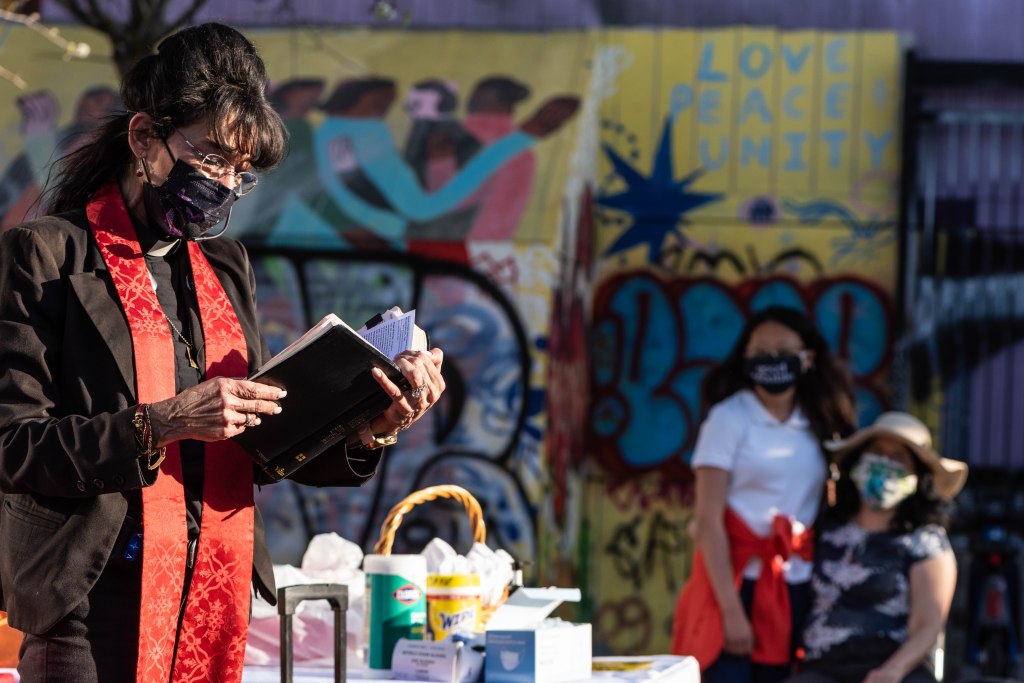
Twice a week, San Francisco Night Ministry holds Open Cathedral services, which are open-air services in the city. The clergy hosting these services have such passion and love for their work, and their parishioners respond in kind. My first Open Cathedral, I just watched these women create sacred space near the Civic Center BART station, not ignoring everything that was happening in the background (pedestrians and bikers coming by, people selling things a hundred feet away, police patrolling) but folding them into the sacred, if that makes sense. (Anyone who has ever shushed a small child during a service should come witness how noise and bustle and the mundane aren’t actually an impediment to holiness, or at least don’t have to be.)
The inestimable Rev. Monique at Open Cathedral in the Mission
During the service, I chatted with one of the regulars, who introduced me to his emotional support animals. It was a delightful conversation. I realized later that what I was noticing in both these little encounters was generosity: how these ministers created such a generous and expansive space, and how parishioners respond with their own generosity. Opening the carrier and showing me his animal companions felt like such a generous act on this person’s part, a way to invite me into his life and make a connection with this new CPE student who was clearly still a little out of their element. And it struck me that we need that kind of generosity in this almost-post-pandemic world; we need people who are willing to stand on literal and metaphorical street corners and just welcome anyone and everyone who comes by, but we also need people who respond, people who are willing to display that same kind of vulnerability and pass a bit of that generous love on to the person next to them.
San Francisco Night Ministry walks the street every night of the year, operates a care line, hosts community programs, and holds outdoor worship services. If you want to support the important work of being present with the most vulnerable among us, click on the link above to donate. Want to know more about the work SFNM does or maybe volunteer yourself? Go to sfnightministry.org for more information.
As some of you know, I’m working with the San Francisco Night Ministry this summer. SFNM walks the street every night of the year to be with some of the most vulnerable people in the city, operates a care line, hosts community programs, and holds outdoor worship services. If you want to support this important work, here’s a link to donate. I’ll be posting regular updates about my experience doing Clinical Pastoral Education (chaplaincy training). Here’s installment one.
On Sundays, a group of people gathers at the UN Plaza in San Francisco, a little ways away from the farmer’s market. This is Open Cathedral, led by clergy connected to the San Francisco Night Ministry. They do all the things congregations do: they pray, sing, take communion, pass the peace, tell their stories and catch up with other people. But they do it outside, on folding chairs, near a farmer’s market and with police patrolling in the background. Some of the regulars are unhoused, others are housing insecure or are struggling in other ways to make ends meet in San Francisco.
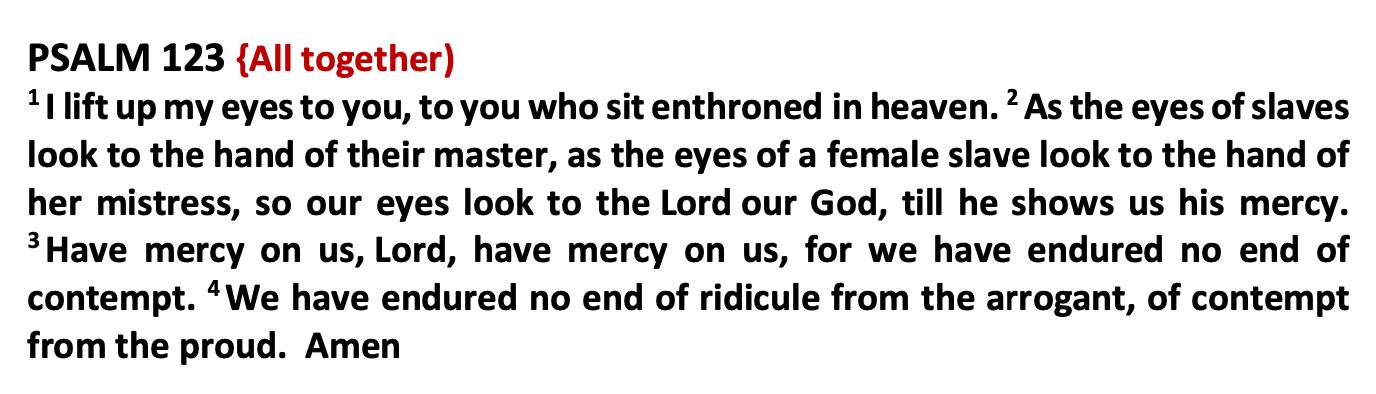
A couple Sundays ago, this was the psalm we said together. I was incredibly moved by the last verses, to be saying them with a group of people who are largely invisible and ignored and who live the reality of this psalm. These are incredibly resilient people, survivors, who faithfully come together every week to lift their eyes to God in the heavens. It’s an honor to be there with them, frankly.
After the service ends, folks head out with a bagged lunch under their arm, and hopefully with a reminder in their heart: that they matter and that they are not forgotten, not by God or by other people. It feels like a drop in the bucket–what’s one lunch, one moment of dignity and respect in the face of so much need?–and like the most important work in the world. That’s ministry for you.
Want to know more about the work SFNM does? Go to sfnightministry.org to learn more and find out how you can help.
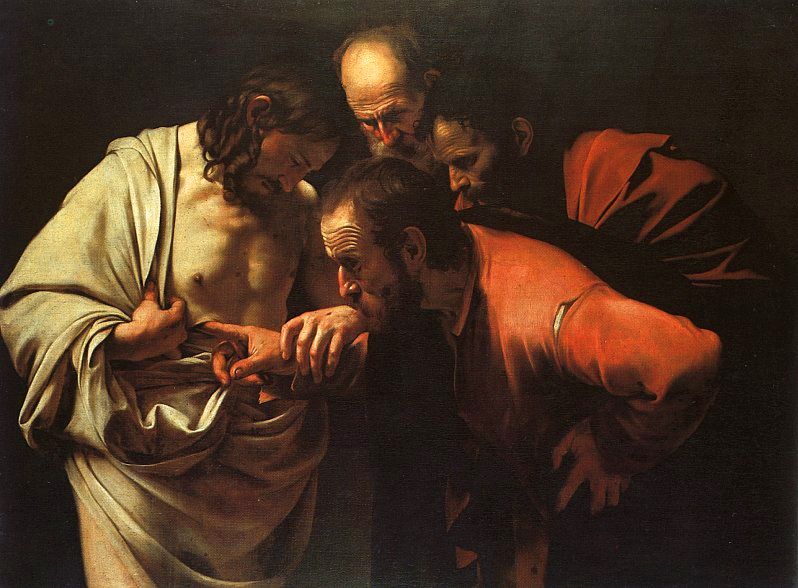
A while ago, an image made the rounds on my social media. It’s a reimagining of Caravaggio’s “The Incredulity of Saint Thomas,” in which Thomas is probing Jesus’s scars after his resurrection. In this photo by Elizabeth Ohlson Wallin, scars are still being probed, but they’re not the scars you traditionally associate with the crucifixion. They’re top surgery scars, instead.
Caravaggio on the left, Elizabeth Ohlson Wallin on the right.
It made me deeply uncomfortable. For as long as I can remember, I have policed all the borders of my body, the ways I dressed and walked and spoke, lest something out me and it become apparent to others what I knew was true. It is hard to unlearn that kind of shame, and every change that transition brought provoked a two-fold reaction in me: happiness, as my selves began to align, and fear, of those changes becoming visible to others. So to see a reimagined Jesus openly displaying those scars, and not just that, but Thomas poking at them? That made me want to hide in the deepest, darkest hole I could find.
Yesterday, on Transfiguration Sunday, my Episcopal parish included a renaming liturgy in their Eucharist and blessed my new name. This is a piece I wrote as a response to that moment, but it is actually a piece that is directed at everyone who has supported me and continues to support me and my family during my transition. Most likely, if you are reading this, it includes you, too.
I. If you are my friend on Goodreads, you may have seen my reading interests shift. Somewhere in the past year, the LGBTQ tag began to appear more frequently. I read memoirs, academic tomes about queer theology, and histories. I searched my library’s catalog and realized most of the LGBT fiction was to be found in the young adult section, so off to the teen corner I went. I read romance novels that were sexy and sometimes cheesy but not heteronormative. And finally I read book after book with transgender in the title. And I cried while I read those, and then I reached for more, because here were my experiences laid out across the page. I sobbed because it turns out there were words for what I felt, there was a whole system of language that could articulate and explain what I’ve known as long as I can remember but never knew how to express. I cried because there was the proof that there were other people like me, that I wasn’t alone, and that I wasn’t broken. I was just transgender.
Lent, I could do. Easter, on the other hand, Easter was harder this year.
I had surgery to repair my fourth degree tear on March 5, the day before Ash Wednesday. A surgeon and a resident made their incisions and reached inside to repair what had been broken when my daughter was born. I had three procedures done in 3.5 hours–I will spare you the details of what exactly they did, but I will tell you that they used a chevron pattern for some of the sutures, or so the surgery notes later told me.
In the waiting room, the doctor told my husband they had been successful, more successful than he had originally thought would be the case. I didn’t hear any of this, of course, I was in the recovery room, with pain that wouldn’t let itself be tamed. I spent hours floating above and then crashing down into the pain, over and over again, as the nurse worked to find a combination of drugs that would keep the pain at bay. My hospital bill had a whole row of charges simply labeled “DRUGS,” expensive evidence, as it were, of the hours I spent wordlessly crying–suffering–in the recovery room. It’s a hazy memory, but a strong one, and I wonder if it will fade.
“We do not own stories, and when we try to limit them, squeeze the life out of them, lose the love that gave them to us and fall back into that fatal human flaw, pride, hubris, we’re right back to Adam and Eve who listened to the power of the snake instead of the creativity of God.” Madeleine L’Engle, Bright Evening Star: Mystery of the Incarnation.
The Virgin Mary has had an outsized influence on my life, which is remarkable if you consider that I’d never really heard her story until I started going to church as a teen. More precisely, Mary has been the bane of my existence since I converted and learned her story and, more importantly, that I was subject to it. What I learned, what was imprinted on me in too many ways to mention, was that Mary was a virgin, Mary was meek, Mary was mild, Mary was a mother above all, Mary was who I was supposed to be because I was a girl. I was not any of those things, even when I tried. I was not like Mary, but I learned I should be.




 Rev. Mees